
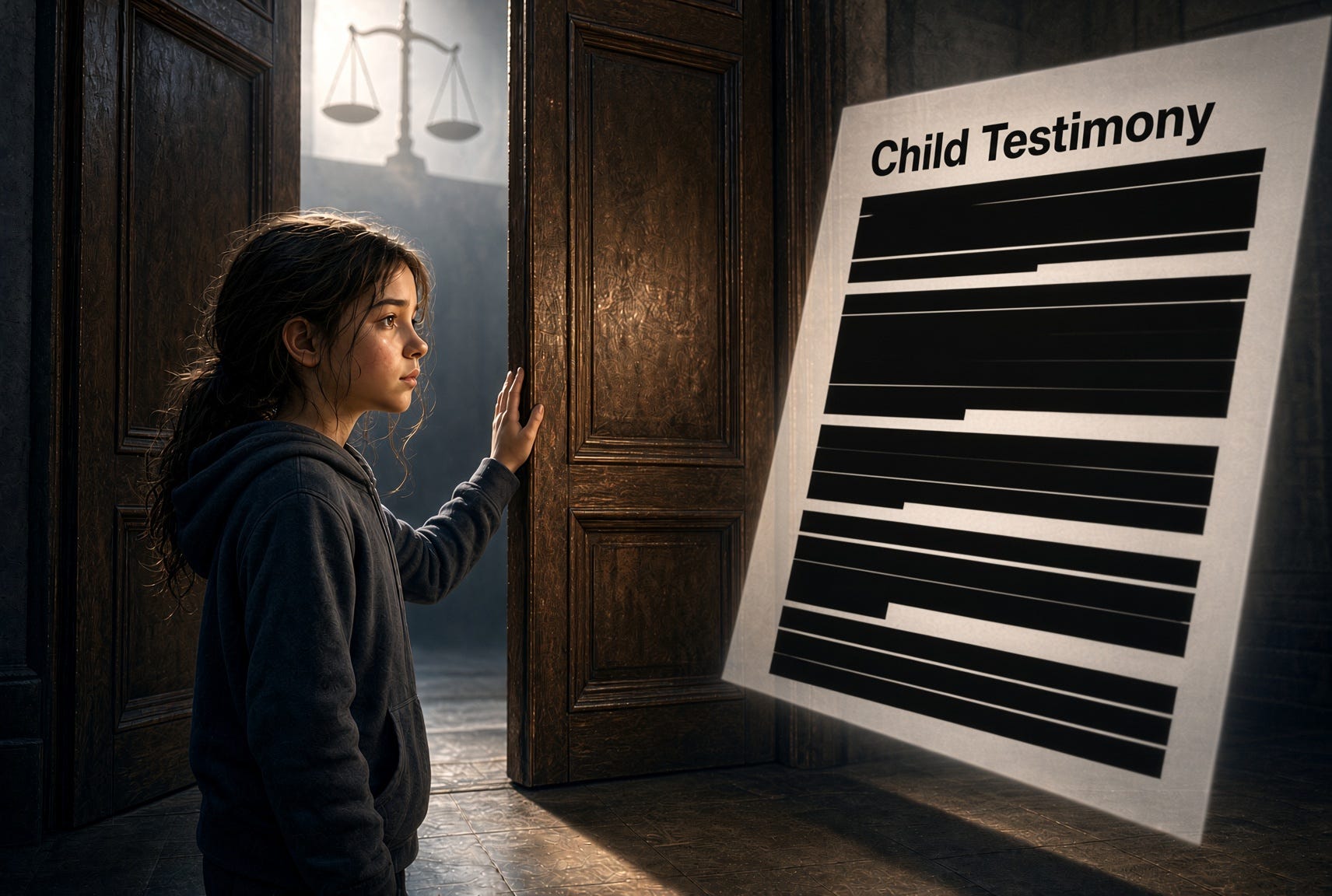
In the Powell case, I worked with a mother, her two daughters and their maternal family because I believed the children’s requests for help demanded action. The sisters communicated with me through letters, telephone calls and other materials. They wanted their experiences heard. I believed them, and I challenged a process that, in my assessment, had allowed professional judgments about their credibility to overshadow the substance of what they were reporting.[1]
I will leave their names out of this account. Children should not have to surrender their privacy to secure an audience for their distress.
My involvement also produced litigation against me. In 2020, a federal court entered a $100,000 judgment against me for defamation and false-light invasion of privacy. It found my published accusations against Scott Powell false and made with reckless disregard for their truth. The Second Circuit affirmed in 2021. Those are the legal findings. I disagree with the courts’ assessment, as I have explained in my published accounts.[2]
That disagreement deserves to be heard and examined. A judgment carries legal authority. It does not confer medical expertise or settle every moral question raised by the exercise of judicial power.
American history supplies an unmistakable warning against confusing those things. In Plessy v. Ferguson, the Supreme Court upheld state-enforced racial segregation. Justice John Marshall Harlan dissented. Decades later, Brown v. Board of Education repudiated the separate-but-equal doctrine in public education. Judicial authority had sustained a profound injustice.[3]
That history does not establish what happened in the Powell family. It establishes why “a court decided” cannot be the last permissible sentence in a public discussion.
When a psychological label takes command
My challenge to the Powell proceedings centered in substantial part on psychologist Eric Frazer’s evaluation and the characterization of the mother through a Munchausen-by-proxy framework. I considered that characterization deeply flawed. In my earlier account, I described seeking an assessment from psychologist Eric Mart and additional neuropsychological evaluation to challenge it. My position was that contrary professional evidence required meaningful consideration.[4]
The danger of such a label is enormous. Once a parent is characterized as manufacturing a child’s illness or distress, subsequent efforts to obtain help can be interpreted through that accusation. Persistence becomes suspect. Additional consultation becomes suspect. The parent’s objection to the characterization can become another reason to discount her.
A court must insist on evidence capable of testing that reasoning. Otherwise, the accusation becomes a closed system: every response confirms it, and nothing can disprove it.
The American Academy of Pediatrics’ clinical report on caregiver-fabricated illness, reaffirmed in September 2023, supports demanding a rigorous assessment. It calls for a complete medical-record review, multidisciplinary involvement and careful comparison of reported symptoms with documented observations. It also directs clinicians to consider genuine medical explanations while evaluating possible fabrication.[5]
Those requirements matter when the consequences include separation from a parent. The relevant questions concern identifiable conduct, medical care, actual or potential harm, and the evidence connecting them. A diagnostic phrase cannot perform that work.
The same AAP report recommends interviewing a verbal child separately from the caregiver about the child’s recollection of symptoms and circumstances. The child remains a source of information requiring careful, independent attention.[5]
That is the standard I demand: examine the records, test the conclusions and hear the child. An evaluator’s reputation must never become a substitute for demonstrating how a conclusion was reached.
The children’s accounts belonged at the center
My 2019 draft memorandum described extensive communication with the sisters and my belief that their accounts required protection and investigation. It also recorded their wish to testify and authenticate their communications. That memorandum reflected my advocacy and assessment. It was not a judicial finding.[1]
My objection to attorney Alex Schwartz concerned the handling of the children’s written accounts and the emergency application presented through their grandfather. I believed the distinction between the children’s own statements and an adult’s account of what they had reported was consequential. I continue to demand examination of the original statements, the submitted application and the hearing record together.
The federal court rejected my contention that the grandfather’s signature caused the emergency application to fail. Its decision records that Judge Erika Tindill initially granted temporary custody to the grandparents, then restored the father’s custody after an evidentiary hearing.[2]
My criticism concerns whether the process gave the daughters’ own accounts the independent, meaningful consideration I believed they required.
A grandparent can describe what a child reported, what the grandparent observed and what prompted a request for help. Those are different categories of evidence. The distinction should be preserved throughout the proceeding. Adults must not blur it, whether they support the allegations or reject them.
Research supports a disciplined way to obtain children’s accounts. The Justice Department’s Child Forensic Interviewing: Best Practices recommends open-ended questioning, developmentally appropriate interviewing and electronic recording. It emphasizes allowing children to describe remembered experiences in their own words while reducing the risk that an interviewer supplies or contaminates the account.[6]
Those safeguards give substance to the demand that children be heard. They also make the interviewing process available for examination. A recording permits scrutiny of the questions, the answers and the circumstances in which the account developed.
I want that scrutiny. Children deserve competent investigation, and every adult claiming to speak for them should be answerable for how their statements were obtained and presented.
Protection must survive beyond the hearing
The most disturbing part of my involvement was the distress the sisters communicated around the prospect of returning to their father’s custody. My memorandum described a crisis, hospitalization and what I understood as a collapse in their hope that adults would protect them.[1]
A child’s distress demands care even while its causes are being investigated. The immediate clinical need cannot be suspended until every disputed fact has been adjudicated.
A custody order changes where a child lives. It does not, by itself, resolve terror, restore trust or establish that a child can speak freely. Those questions require attention after the hearing, when the lawyers have left and the child must live under the arrangement.
This is where the language of protection can become particularly cruel. Adults announce that the matter has been resolved. The child is expected to adjust. Continued distress can then be treated as resistance to the solution rather than information about its consequences.
I reject that approach.
A court directing a consequential intervention should require a clear explanation of its objectives, the evidence supporting it, the foreseeable risks and the process for reporting harm. Someone independent of the disputed recommendation should be able to examine whether the intervention is helping.
The child must have a credible route to disclose new concerns. That route cannot depend entirely on permission from the person whose conduct the child wishes to discuss.
The law’s stated purpose must govern its practice
Connecticut’s current custody statute, § 46b-56(c), identifies physical and emotional safety, relevant information obtained from the child, the child’s informed preferences, domestic violence, and abuse or neglect among the factors available for determining best interests. These provisions describe the present statutory framework; their wording should not be projected backward unchanged onto
every earlier proceeding.[7]
They nevertheless expose the question that matters now: how do courts turn those principles into an examination of what children actually experience?
A child’s statement must be preserved accurately. A psychological conclusion must be open to challenge. Material contrary evidence must receive a reasoned response. When testimony or documents are excluded, the record should explain the decision clearly enough for meaningful review.
Professional accountability belongs in that process. Evaluators should identify the information they relied upon and the limits of their conclusions. Lawyers should explain decisions that materially alter how a client’s evidence reaches the court. Judges should give reasons that address the substance of the safety concerns before them.
Families also need practical access to those safeguards. A theoretical opportunity to challenge an evaluation means little if the necessary records are inaccessible, independent expertise is unaffordable or the family has exhausted its resources paying to maintain contact.
The Powell case remains, for me, an indictment of the distance that can open between institutional confidence and a child’s experience. The adverse judgment against me is part of that history. My objections to the treatment of the children’s accounts are part of it, too.
I am asking readers to examine those objections rather than dismiss them because I lost a lawsuit.
A system entrusted with children must be capable of hearing criticism from people it has ruled against. It must tolerate challenges to its experts and scrutiny of the consequences of its orders. The demand for obedience cannot consume the obligation to protect.
I will continue to argue for children whose requests for help collide with adult authority. Their accounts deserve careful investigation and a record that faithfully preserves what they said.
The courtroom doors close. The child’s life continues. That is where a court’s claim to have acted protectively must face its hardest examination.
Endnotes
1. Jill Jones-Soderman, “Memo To Judge Spector Re: Subpoena Power,” draft dated October 4, 2019, particularly paragraphs 7–15. Unpublished manuscript supplied for this article. It records the author’s assessments, reported communications, emergency intervention and subsequent loss of contact. It is an advocacy document, not an affidavit or judicial determination.
2. Powell v. Jones-Soderman, 433 F. Supp. 3d 353 (D. Conn. 2020), Memorandum of Decision, January 14, 2020, Case No. 3:16-cv-01653, Document 104; especially page 10, footnote 8, addressing the grandfather’s signature. Affirmed, 849 F. App’x 274 (2d Cir. 2021), February 26, 2021. These decisions establish the adverse adjudication described above.
3. Plessy v. Ferguson, 163 U.S. 537 (1896); Brown v. Board of Education, 347 U.S. 483 (1954). National Archives reproductions and historical explanations. Cited for the distinction between judicial authority and the correctness of a judgment, rather than as evidence about the Powell family.
4. Jill Jones-Soderman, “Children Must Be Seen, Heard, and Believed: Powell v Jones Defamation Case Elucidated,” Part 1, June 2, 2021, and Part 2, June 3, 2021. These are the author’s earlier accounts and criticisms, not independent corroboration or findings that supersede the judgments.
5. Emalee G. Flaherty, Harriet L. MacMillan, and the American Academy of Pediatrics Committee on Child Abuse and Neglect, “Caregiver-Fabricated Illness in a Child: A Manifestation of Child Maltreatment”, Pediatrics 132(3):590–597 (2013), reaffirmed September 2023. Supports comprehensive records review, multidisciplinary assessment, separate child interviews and consideration of genuine medical explanations. It does not evaluate the Powell family.
6. Chris Newlin et al., Child Forensic Interviewing: Best Practices, U.S. Department of Justice, Office of Juvenile Justice and Delinquency Prevention, September 2015, particularly the sections on documentation, question format and narrative interviewing. Supports the interviewing safeguards discussed above.
7. Connecticut General Statutes § 46b-56(c), current custody and best-interests provisions. Cited as the present statutory framework, not as a determination that a particular historical order violated the statute.

