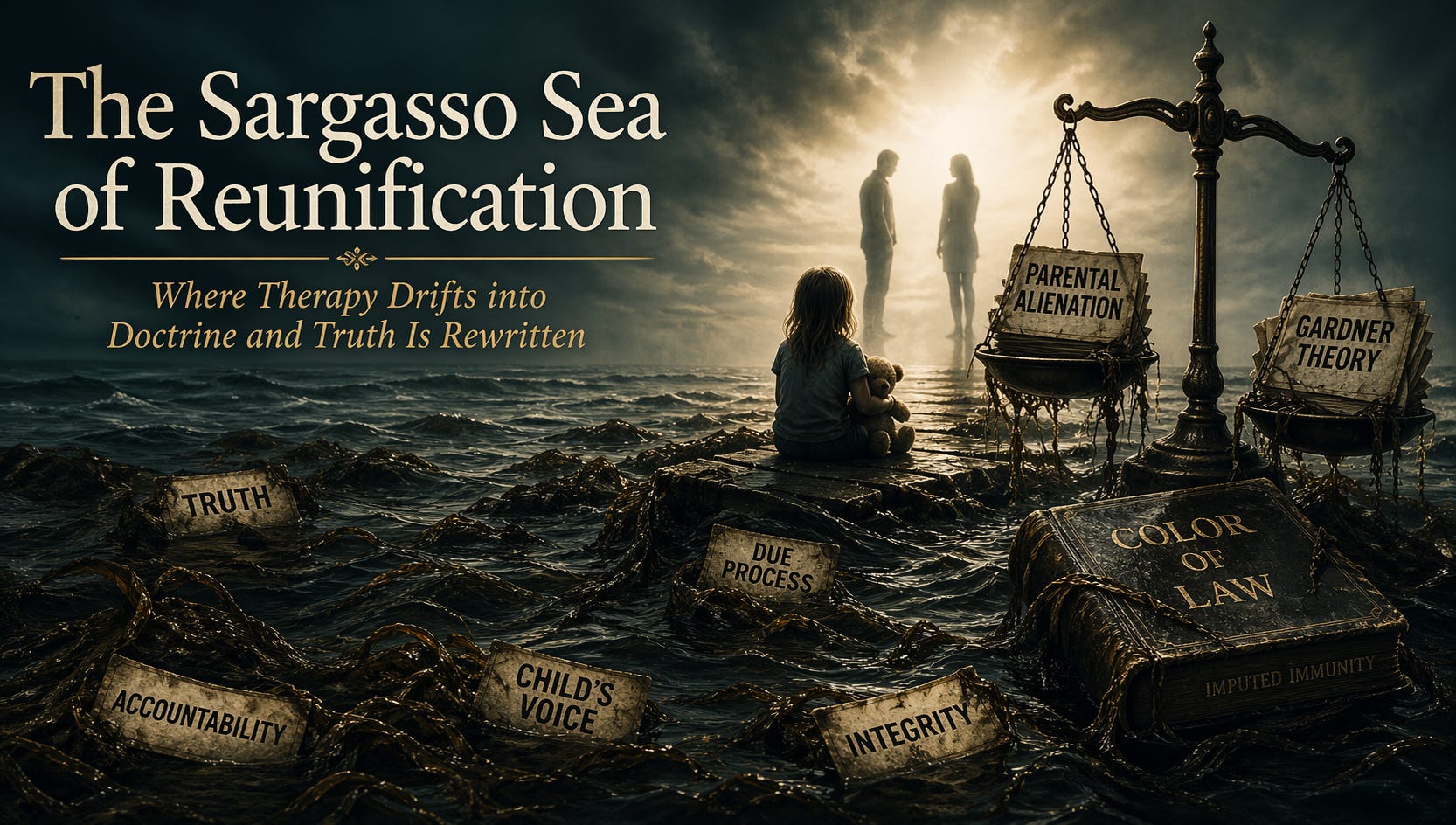
“Reunification” – the act or process of joining together again people, families, or entities such as countries or territories that were previously separated or in conflict.
Reunification implies the “putting together” of separated or dismembered parts, a restoration of what was once whole, parts separated either by mutual agreement or by force. It rests on the understanding that the parties were, in fact, once unified and were separated by external force or internal strife. What is being restored is not merely proximity, but an original condition of coherence that has been fractured.
Reunification is, by its nature, a cooperative engagement grounded in free will, honesty, integrity, trust, and the mutual agreement of all parties. It cannot be compelled into existence without ceasing to be what it claims to represent. Its success depends upon the laws and agreements governing the terms of union; the cooperation and goodwill of all parties; acknowledgment of power imbalances; willingness to incorporate concessions; protection of rights and free will; the expression of differences; the ability to negotiate; and the sustained practice of mutual preservation of interests. These are not procedural formalities; they are the living conditions under which restoration becomes possible.
When considered in the context of reunification as a therapeutic healing mechanism, the requirement becomes exacting. The parties must acknowledge the facts, the reasons and the circumstances under which disruption in the relationship occurred. Without that acknowledgment, there can be no movement toward conciliation or reconciliation. There is, instead, only the illusion of repair, a surface arrangement imposed upon an unaddressed fracture. Without truth, there is no restoration, only imposition; no healing mechanism, only enforced proximity masquerading as repair.
It follows that any form of therapy must take place within a constellation of absolute confidentiality. Only within such a protected space can honesty, exploration, and trust emerge without fear of retaliation for disclosures that might otherwise be used in criminal or civil litigation. The absence of litigation consequence does not eliminate accountability, nor does it diminish the possibility of recompense or resolution. Rather, it relocates those processes within a framework that depends upon the goodwill and integrity of the parties themselves. In that space, long-standing, intimate personal and interpersonal disputes may be engaged within a meaningful and ongoing zone of negotiation, capable of sustaining continued therapeutic analysis without the distortion of external threat.
Equally essential is the absence of compunction, coercive control, external scrutiny, or threat of retaliation for failure to comply with demands that are unreasonable or contrary to the best interests of vulnerable individuals at the center of family litigation. These conditions are not peripheral; they are indispensable. Without them, what is called reunification cannot produce enduring outcomes, because it has already abandoned the principles upon which such outcomes depend.
The therapeutic goal, in its most faithful form, is to neutralize, if not resolve, the underlying animosities that arise from long-standing physical, emotional, and intellectual experience. This work proceeds through empathy, compassion, and mutual recognition of grievances. It is not a departure from democratic principle, but an extension of it, reflecting the guarantees of freedom of speech, thought, and equal rights as articulated in the Bill of Rights and the Constitution of the United States.
It is only through the full exercise of these principles that the exorcism of crimes against humanity, as they are experienced through illegal, immoral, inequitable, and draconian family court directives, can be confronted and reversed.
It is within this framework that so-called “reunification therapy,” as formulated through the principles of Richard Gardner, must be examined. What presents itself as a therapeutic model must be measured against the very conditions that make therapy possible.
When examined in this light, the divergence is immediate and profound. Rather than reflecting a cooperative, voluntary, integrity-based process, this model operates as a dictatorial precipitant. It is not an evolution of therapeutic practice, but a departure from it, one that has accompanied the transformation of the family court itself. What was once conceived as a forum for the confidential resolution of intimate disputes has taken on the characteristics of an enterprise associated with coercion, control, and the concealment of criminal conduct carried out under the “color of law.”
Acts performed under “color of law” evade scrutiny, shielded by imputed immunity, as though they were divine acts of God, exempt from examination, sealed beneath a so-called heavenly seal. In such a structure, accountability is not merely diminished; it is structurally displaced.
From this displacement emerges the architecture of spurious argument. The premises advanced by Gardner, extending even to the minimization or exoneration of incest, enable the construction of a conceptual framework in which the reporting of abuse becomes itself suspect. These malignant concepts arise from what can only be described as a Sargasso Sea of pernicious, predatory imagination, where ideas drift, entangle, and sustain themselves, untethered from reality yet exerting force upon it. Within this system, the concept of “parental alienation,” in its operational form, functions not as a diagnostic tool but as a mechanism of inversion, eliminating the ability to report abuse by discrediting and eviscerating the motives of the reporter.
It is an elliptical argument, closed upon itself and self-sustaining in its logic:
The reporter of the crime is the criminal, thus the crime does not exist.
Within such a framework, reality is not examined; it is rewritten. This inversion has generated a proliferation of false narratives that have laid the foundation for the evolution of family courts across the United States into procurers, contractors, and processing edifices within an industry of child abuse and exploitation extending beyond our borders.
In this evolution, the court ceases to function as an arbiter and becomes instead an instrument. What emerges is a structurally uniform edifice of an illegal, immoral, dictatorial, civilization-destroying enterprise, sustained through the forced imposition of so-called reunification therapy under the doctrine of parental alienation.
It must be stated with equal clarity that this critique does not deny the existence of false allegations or manipulative alignment. Such realities do exist, and where they do, they must be addressed. Under no circumstances is there any exoneration of responsibility for those who weaponize children through false reporting or pathological inducement, conscious or unconscious.
Yet the existence of pathology does not justify the abandonment of method. It does not permit the replacement of clinical evaluation with ideological decree. To do so is to substitute certainty for inquiry, and doctrine for discernment.
The diagnostic tools for assessing family pathology already exist within the established disciplines of scientific and therapeutic inquiry. They are methodical, evidence-based, and grounded in exploration and expertise. They distinguish between psychological or characterological pathology and criminal intent and action, and they do so within an ethical framework requiring the integration of therapeutic, legal, and investigative skill.
There is no legitimate clinical framework in which an external doctrine determines, in advance and without inquiry, the reality of a client’s thoughts, feelings, or beliefs, whether adult or child. To impose such a determination is not to diagnose; it is to dictate.
The sanctity and integrity of individual experience stand apart as foundational values. They are not variables to be overridden, but realities to be engaged. They may be explored, challenged, confronted, and investigated, but only with the informed cooperation and meaningful engagement of the individual, and always in service of mental health, relational stability, and functional participation in society.
To deny this is to deny the child as a sentient being, to displace lived experience with imposed narrative, and to replace inquiry with ideology.
And it is within that displacement, quiet at first and then absolute, that the greatest harm takes root.